The Definitive Surfboard Fin Guide
Fin Basics
Click the below link to jump to the section:Fin Size | Fin Base | Fin Depth | Fin Rake | Fin Foil | Fin Cant | Fin Toe
Some more advanced stuff...
For more info on the advanced fin characteristics, click the link below to jump straight to it:Fin Shape | Construction and Materials in Surfboard Design
Fiberglass Fins | Composite Fins | G10 Materials |Performance Core Fins | PC Materials and fin flex
Popular Fins
Shop All FinsChoosing the right fins for your surfboard
The fins you put in your favorite surfboard can play a huge role in your performance on that board. Some people evenclaim that your choice in Surfboard Fins can impact up to 40% ofyour performance. With so many different boards and different conditions, it’s important to think about different finsand fin setups that work the way the shaper intended the board to be ridden.The best thing is, just like surfboards, fin design, templates and experimentation is almost endless.
Before you dive head first into testing, it’s great to know a little bit about how each characteristic can impact yoursurfing performance. Let’s start with the basics.

Craig Anderson showing some extreme release on his signature Futures template in Blackstix construction. That is perfectly tailored to the way he surfs.
Fin Size
The size of the fin is going to impact your performance. A larger fin generally will have more hold and also provideplenty of control in bigger surf. A smaller fin, on the other hand, is going to be more forgiving and loose but you’regoing to sacrifice a lot of drive and control in bigger surf.
Difference between the FCS II Filipe Toledo Large template and the Filipe Toledo Medium. Same size base different fin area (mm²).
Fin Base
The part of the fin that is actually attached to the board is called the base of the fin or the fin base. A longer (orwider) fin base is going to help with your drive. This translates into drawn-out turns. Compare this with a narrow, orshort fin base that is going to let you turn a little easier and sharper but without as much of that drive.Fin Depth
The fin depth or fin height refers to just how far the fin extends away for the bottom of the board. A deeper fin in thewater is going to have more hold and stability than a shallow fin. The more shallow a fin, you are going to get morerelease when you throw that tail around through turns.
Fin Base and Fin Depth highlighted on the Futures - John John Florence Fin and the FCS II Mick Fanning Fin.
Fin Rake
When you’re looking at the arc of the fin and how far back it tilts or sweeps, you’re looking at the fin rake. Thelarger the degree of rake, the more drawn out your turns will be. This is great for those bigger days with a nice longwall to work with. Less fin rake and a more upright fin template, means that you’re going to get some more pivot out ofthem – great on junkier, weaker days.The more 'Rake' the less 'Pivot' a fin will have.

The degree of surfboard rake or surfboard sweep determines whether you have a looser feeling in your fins or you get more pivot out of them.
Fin Foil
The fin foil is an aerodynamic shape from front to back of the fin. Much like the wings on a plane, this foil generateslift under the board. A fin is usually going to get thicker through the center of the fin and taper smaller out towardsthe edges.There are a couple of types of fin foils with many variations on each. Side fins (on twins, thrusters and quads) aregenerally flat, sometimes curved inward on the inside and with a foil on the outside. Center fins will mostly have equalfoil or double foil on each side. Commonly referred to as 50/50 or Symmetrical, these equal foils are usually found on single fins, the center fin on a thruster, or sometimes on quad rear fins and some keel fins on traditional fishes.

Fin foil determines the volume of a fin as well as how the water moves past your fins' sides.
Fin Cant
Fin Cant is the degree of outward angle a fin has in relation to the bottom of your surfboard. If a fin has zero cantit’s position straight up and down at a right angle to your board. This is going to be fast in a straight line, but itwon’t give you as much responsiveness through turns. If the cant of your fin is larger, your going to gain a little moreof that responsiveness through your turns. It means you can maintain some more drive when your board is tilted on therail.
More Fin Cant means your fins are angled outward in relation to the bottom of your surfboard.
Fin Toe
The toe of your fins set up is relating to the angle that your fins are pointing at towards the stringer. This occurs alot in side fins with the front of the fins pointing towards the center of your board. This can help create pressure onthe outside foil of the fin. This in turn, allows you to have a little more responsiveness on your board.
The Toe of a surfboard fin above shows the side fins angled towards the stringer.
Check out some of Mick Fanning’s thoughts on thruster vs quad setups as well as why he chooses to change up his FCS IIfin sizes.
Mick Fanning explains how he uses his FCS II fins in different conditions.
Fin Shape
Now that you’ve got the basics and all the lingo for fins, you need to understand a little more complicated aspectsabout how fin shape can contribute to the overall surfing performance.Your fin’s shape impacts directly on how your surfboard is going to perform. One way to comprehend this is to use a Single Fin for our descriptions.
When you get down to it, 2 fins, 3 fins, 4 fins, and 5 fins are more or less variations of these characteristics just in asmaller version.
Flex is one of these characteristics that can directly relate to fin performance.
Flex will contribute to your projection out of turns, which in turn will produce your speed and effect control. Moredetails on flex will follow, but for the purpose of this article, lets look at how flex and shape of fins go hand inhand.
Lets go back to our longboard and check out how it’s going to performusing 4 different fin shapes:
The Flex Fin, the Rake Fin, the Pivot Fin and the D Fin

Different shapes of Single Fins from left to right Flex Fin, Rake fin, Pivot Fin, D Fin.
The Flex Fin (with maximum flex) is a really versatile fin that can be used in just about anything from shorterstubbies to 10 foot nose riders. These flex fins are going to feature a wider base that really tapers down into a narrowtip and doesn’t offer too much drag. When coming off a bottom turn, your flex fin will give you a tonne of projection.
This reflects what we mention earlier where the more rake you have in your fin, the more you can draw out your turnscompared with a rigid upright fin template for more pivot in tighter turns.
The Rake Fin (with medium flex) is the next most flexible and sits between the flex fin and the pivot fin alongthe spectrum. With a wide base like before but with a little more width in the tip of the fin you can see a fairlyvertical base that sweeps back towards the end. This combines nicely the projection and maneuverability of the flex finwith some of the holds you get from a Pivot Fin.
The Pivot Fin (with very little flex) is your standard go-to fin-shape for nose riding. You can recognize thisfin by it’s full, vertical outline with a wide base. It’s designed to slow you down a little and help keeps the tailfurther in the water while you’re up on the nose. You can also still step on the tail and pivot (swing) the board aroundin a relatively tight radius.
For tips on noseriding, check out our guide on How to Noseride.
The D Fin (no flex) is original surfboard fin. Usually found on more classic, traditional logs, they work wellfor holding trim down the line, similar to the Pivot fin, the D Fins large surface area helps keep you locked on thenose. However, they are much harder to turn in a tight radius.
With a super wide base combined with a super wide tip, these fins get their name from generally appearing in the shapeof a D. Sometimes you can find them with a straighter, more vertical forward edge with a curved side aft, and sometimesthey’re found with curved edge forward and vertical edge aft.
You would usually place these fins as far back of your board as possible for maximum down the line trim.
To learn more, check out our dedicated Longboard Fin Guide.

Believe it or not, this original photo of Robert August and friends in the 60’s depicts them holding the most modern surf craft of the time.
Surfboard Fins 101
So now you know a little more about fins. With literally an infinite number of surfboard and Surfboard Fins combinations, you’re going to have a good time testingthem all out.Check out Part Two of our Fins Guide below for a better understanding of materials and construction in surfboard findesign.
Part 2 - Construction and Materials in Surfboard Fin Design

Futures Fins giving us a look at the mold for their Alpha Fins. Alpha fins are made up of a carbon fiber compound that is strong and light.
The same way surfboard combinations and design are endless, so are surfboard fin combinations and choices. It’s onlythrough experimentation that the best performing fins are going to be found and with so many aspects like materials,construction, cores and design able to be adjusted, it’s no wonder great discoveries are still being made.
However, while experimentation and innovation are great, there are also some proven design aspects that have stood thetest of time, and some things we’ve learned to look for when we’re matching our fins with our surfboards

Kolohe Andino demonstrating why high performance surfing needs high performance fins. Throwing his signature FCS II template to the beach.
Recap of Part 1
In part one, we talked about flex and fin shape and how they are key elements in making a fin act the way itdoes.Flexible, raked back fins for sweeping turns and some projection can be used, or more stiff and upright fins to giveyou sharper turns and a quick release. With a wide range of varying degrees in between both.
Fiberglass Fins
One of the traditional constructions found is the fiberglass fin. The construction of these fins involve laying upmultiple layers of fiberglass cloth and resin and then cutting and foiling the fiberglass fin shape by hand. These finsare strong. Although the thinner you sand them back the more they will flex. For shortboards, the size of the fins meansthey are usually quite stiff. A stiff fin is the go-to for powerful waves when you want to control and stability.This type of construction is also great for traditional surfboard styles in single fin, and twin fin templates where amore sturdy fin is required. They aren't the lightest fins on the market which is why progressive surfers who want to goabove the lip with airs will often choose a different construction.

Connor Coffin demonstrating the right time to use his Futures fiberglass fins. Grabbing rail for the power carve on a heavy wall of water.
Composite Fins
Composite fins are fins that use more than one material within the construction.Standard fins that come with most boards are generally made of a basic natural composite.
Once you have all the equipment, it becomes extremely easy to produce a large number of these fins.
The technique for making these fins is called Resin Transfer Molding or RTM. This process involves injecting resin withfiberglass into a mold that results in a plastic like fin that’s both lightweight and strong.
While these are great to produce on mass, you definitely can’t quite get the right flex properties that you want in afin.
Dave Rastovich talking about how quad setups help his style of surfing; how material can affect both the flex and stiffness of a fin; and how his Futures Quad Fins incorporate bamboo into the base of the fin to promote strength and extra drive.
G10 Materials
The next progression up from the basic Natural Composite fin would be a fin made using G10 material.The G10 method is widely used through several industries and uses an epoxy and fiberglass laminate. Fins made this wayare both flexible and extremely durable. G10 fins are generally a little stiffer and have controlled flex thatresults in plenty of drive and control.
So how could fins get more hightech? This is where we start to play around with things like cores and high gradematerials like carbon and kevlar.
Performance Core Fins
You can make the core of a surfboard fin out of almost any material you want. The most popular core going around highperformance fins at the moment is generally a honeycomb/hexagonal design that's made from lightweight and extremelystrong materials. This type of design provides a unique stiffness and flex pattern through the fin in a superlightweight construction.This process generally uses the standard RTM method mentioned above and has standard fiberglass and resin wrapped aroundthe core.
This performance core style of fin has changed fin development forever. However, it doesn’t end there. It’s theexploration into ultra high tech materials that make this style of fin progress to the next level.

Now that larger fins can still be a light alternative, surfers such as Ozzy Wright have been utilizing a Twin + small stabilizer fin set up to increase drive down the line into air sections. Seen here in the Texas wave pool with the MR Twin in Performance Core construction.
PC Materials and fin flex
The use of carbon, kevlar, texalium, individually or all together can result in a variety of different flexpatterns.Each different design, construction and type of material is going to store and release energy generated through yourturns or when driving down the line in very different ways.These kinds of constructions and crazy materials experimentation are generally found in ultra high performance fins and– like we’ve said all along – can be combined in as many different configurations as you can think of.
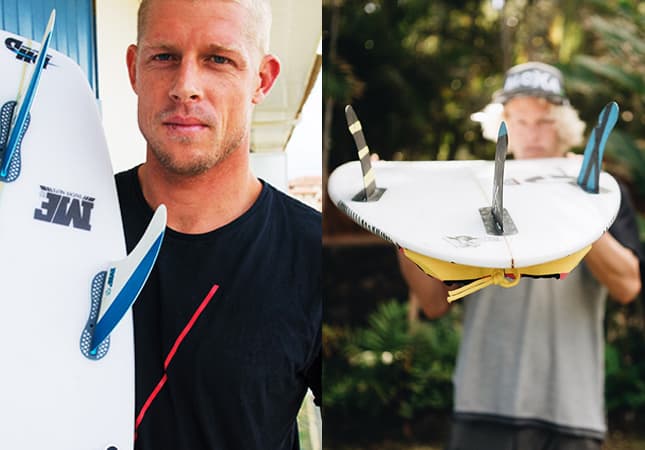
Mick showing off his FCS II dual tabs while John John is a single tab Futures Fins man.
In Summary...
Choosing fins, just like choosing surfboards, provideyou with an almost unlimited amount of experimentation and potential.The constructions and materials mentioned above only touch the surface of what is possible in experimentation and findesign. There are an unlimited amount of combinations that can be used for the cores and skins of fins that all playaround with flex patterns, weight and the strength of your fins.
With all of these various materials combined with foils, shapes, design and everything else, you can see why theexperimentation of Surfboard Fins is going to continue on for sometime!
So next time you grab your board and throw in your usual fins, try changing them up. Use something different and you mayjust find the combination that changes the way you surf forever.